If you’ve started reading collagen labels closely, you’ve probably run into a number that doesn’t get explained: molecular weight. It’s one of the few specs that actually tells you something about how a collagen is made — and it’s central to why low molecular weight marine collagen has become the form serious label-readers look for.
Here’s the honest version, without the hype. Collagen results vary from person to person. Digestion, peptide size, and individual physiology all play a role in how collagen-derived peptides are broken down and used by the body.* This article walks through the four pillars behind what we call the Science of Glow — and why peptide size is where the story starts.
What is low molecular weight marine collagen?
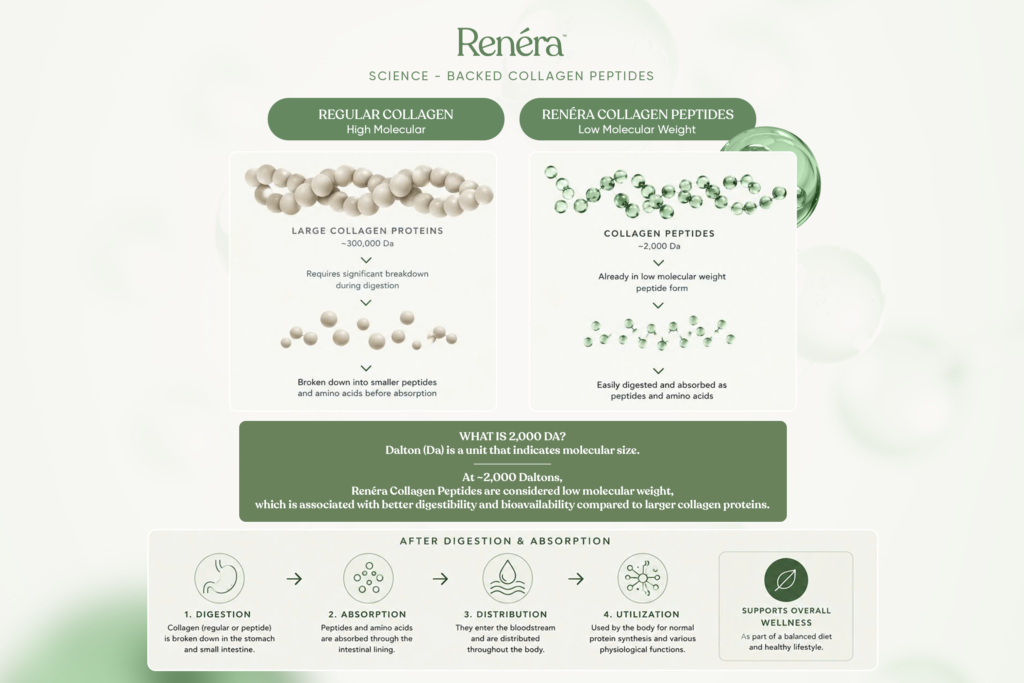
Molecular weight is measured in Daltons (Da). Native collagen is a large structural protein — roughly 300,000 Da — far too big to pass through the intestinal wall intact. Before any of it reaches your system, digestion has to break it down into smaller fragments.
That’s the entire reason hydrolyzed collagen exists. Through enzymatic hydrolysis, manufacturers pre-break collagen into peptides, typically in the 3,000–5,000 Da range. By comparison, low molecular weight marine collagen sits lower still — and lower-molecular-weight peptides have better water solubility than larger intact protein, which is a measurable quality of the formulation itself.*
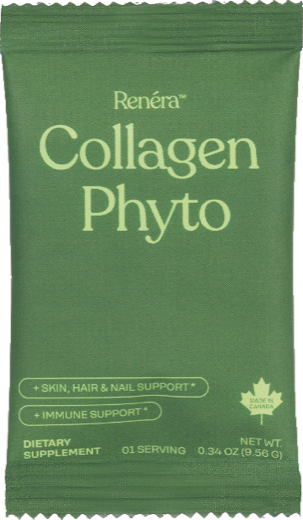
Renéra™ Collagen Phyto uses low molecular weight marine collagen peptides (~2,000 Da), produced through a clean enzymatic process in Europe and designed for solubility.* It’s Type I marine collagen — the type that makes up the majority of skin’s collagen.
A note on solubility vs. absorption: Solubility (how well a powder disperses in water) and absorption (what the body actually takes up) are two different things. We talk about solubility because it’s a real, observable property of the formula. We don’t claim that dissolving in a glass proves anything about what happens inside the body.
Peptide size and digestion
Once low molecular weight marine collagen is hydrolyzed and consumed, small peptides and amino acids are taken up through intestinal transport systems, including a well-studied transporter called PEPT1 that handles di- and tripeptides.* From there, these components enter circulation as raw material the body can draw on for its own protein synthesis — including the processes involved in maintaining skin structure.*
This is the part marine collagen is best known for: a low molecular weight profile and an amino acid composition rich in glycine and proline, both relevant to skin and connective tissue.
Collagen as nutritional support
Bioavailability is only one part of the picture. Renéra is formulated with a full 7,000 mg serving of low molecular weight marine collagen peptides per dose. Following digestion, the resulting amino acids and small peptides may contribute to the body’s natural processes involved in collagen, elastin, and extracellular matrix maintenance.*
Emerging research suggests certain collagen-derived peptides may also support normal fibroblast function under physiological conditions — part of how the body maintains its own collagen and elastin.* These effects are indirect and not fully understood, and outcomes depend on age, diet, lifestyle, and overall metabolic health. We’re describing nutritional support for normal processes, not a drug effect.
The postbiotic layer (LC-Plasma)
Here’s where Phyto separates from most collagen on the shelf. Skin health isn’t only structural — overall physiological balance, including immune function, plays a role too.
Renéra includes LC-Plasma (Lactococcus lactis strain Plasma), a heat-treated postbiotic. Unlike probiotics, postbiotics are non-living bacterial components, which makes them more stable and easy to take daily. LC-Plasma is clinically studied for its potential to support innate immune activity. Research suggests it may interact with plasmacytoid dendritic cells (pDCs). These cells are involved in early immune signaling.*
Why include it in a beauty formula? Chronic low-grade inflammation is one of several factors scientists associate with changes in skin over time (sometimes called “inflammaging”). Supporting normal immune function and inflammatory balance is one piece of a whole-body approach to skin.* LC-Plasma helps support immune resilience, particularly during periods of physical or seasonal stress.*
The phytonutrient antioxidant complex
The final pillar focuses on helping protect skin’s structural proteins. It shields them from oxidative stress, a key environmental factor in skin aging. UV exposure and pollution increase reactive oxygen species (ROS). Elevated activity of enzymes called MMPs, including MMP-1, relates to the natural breakdown and remodeling of collagen. MMPs are part of normal skin turnover; the goal is supporting balance, not “neutralizing” anything.
Renéra includes a water-extracted blend of six fruit extracts:
- Acerola — a natural, bioavailable source of Vitamin C, a recognized cofactor in normal collagen synthesis*
- Pomegranate (punicalagin) — supports antioxidant defense and radiant-looking skin*
- Olive (hydroxytyrosol) — supports skin against everyday environmental stressors*
- Amla (beta-glucogallin) — free-radical neutralization*
- Grape seed (OPCs) — free-radical neutralization, supports healthy aging*
- Black & red currants — skin vitality and overall wellness support*
Together, these support the body’s natural response to oxidative stress — one of several factors linked to skin aging.*
Why solubility shows up the way it does
When a single-serve sachet of Renéra Collagen Phyto is stirred into water, it disperses smoothly with minimal clumping. It forms a uniform solution. This is characteristic of low molecular weight marine collagen peptides. These peptides are processed to dissolve more easily than native protein.* The natural mauve-pink color comes from anthocyanin-rich berry extracts, which are water-soluble plant pigments.
Solubility is a useful signal of formulation quality and a better drinking experience. It is not, on its own, a measure of what the body absorbs — that depends on digestion and metabolism.
The bottom line
Healthy-looking, resilient skin is shaped by many things: nutrition, structural proteins, environmental exposure, and the body’s own physiological processes. Renéra™ Collagen Phyto is built around three complementary pathways:
- Structure — low molecular weight marine collagen peptides (~2,000 Da) at a full 7,000 mg serving, providing amino acids that support the body’s natural collagen and connective tissue processes*
- Resilience — LC-Plasma, a clinically studied postbiotic that helps support immune health*
- Defense — acerola Vitamin C plus a six-fruit polyphenol complex that helps protect against oxidative stress*
That’s the Science of Glow: structural support, antioxidant balance, and whole-body wellness in one daily ritual. Research is ongoing, and individual responses vary with age, diet, environment, and overall health.
* These statements have not been evaluated by the Food and Drug Administration. This product is not intended to diagnose, treat, cure, or prevent any disease.
References
- Identification of food-derived collagen peptides in human blood after oral ingestion of gelatin hydrolysates. J Agric Food Chem. PubMed 16097765
- Oral intake of specific bioactive collagen peptides reduces skin wrinkles and increases dermal matrix synthesis. Skin Pharmacol Physiol. PubMed 24401291
- Immunomodulatory effect of Lactococcus lactis JCM5805 on human plasmacytoid dendritic cells. Clin Immunol. PubMed 26362947
- Role of Plant-Derived Antioxidants in the Prevention of Skin Aging and Oxidative Stress. Int J Mol Sci. MDPI