The morning after a celebration, skin tends to tell the story before you do. A late night, a few drinks, salty food, and a short night of sleep can leave a complexion looking dull, puffy, and tired. If you have ever wondered how to repair skin after partying, the honest answer is that no single product does it alone. What helps is a calm, consistent reset that works from within.
This article takes an evidence-led look at why skin looks tired after partying, how the gut-skin connection shapes recovery, and how a thoughtful, non-toxic skin recovery routine may support a steady daily glow from within.* Outcomes may vary depending on lifestyle, diet, sleep, stress, and individual health.
Why Your Skin Looks Tired After Partying
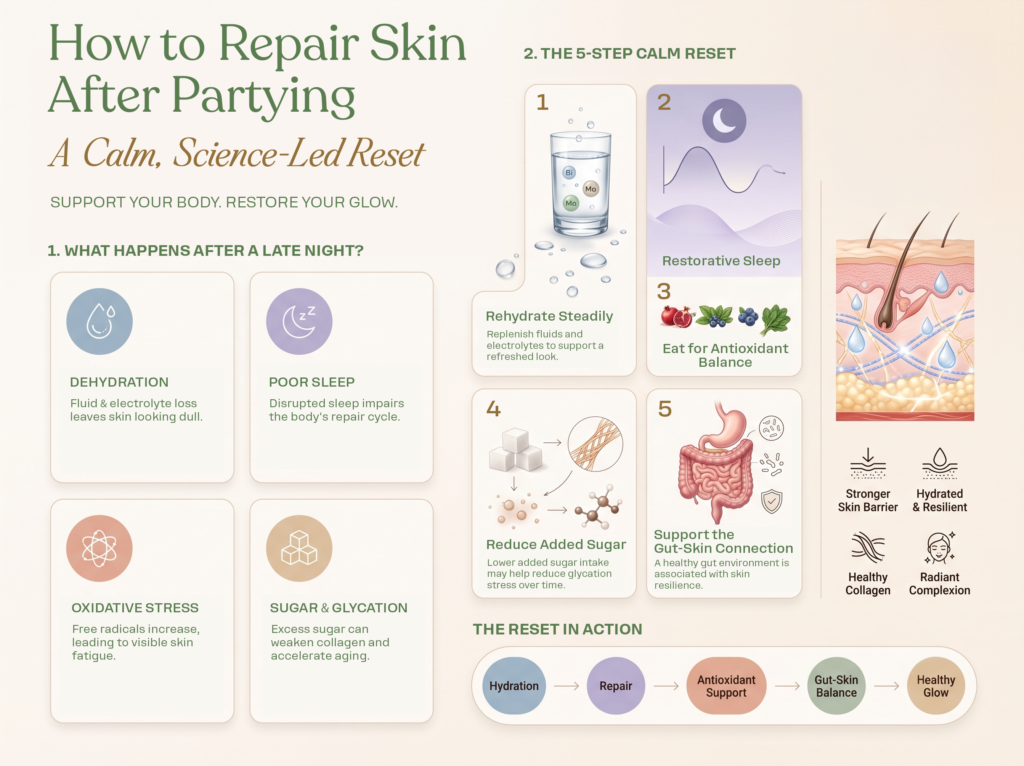
Before looking at how to repair skin after partying, it helps to know what actually changed overnight. Several ordinary factors stack up during a celebration, and skin reflects the sum of them.
Temporary dehydration
Alcohol has a mild diuretic effect that can contribute to temporary fluid loss. When the body holds less water, skin can appear less plump and more textured. Salty or sugary party food may add to fluid shifts and next-morning puffiness. This is why skin after drinking alcohol often looks noticeably better within a day of steady rehydration, without any product at all.
Short or disrupted sleep
Adults are generally advised to get seven or more hours of sleep per night. During rest, the body carries out many of its normal maintenance processes, including those involved in skin barrier function and overall tissue homeostasis. A single short night can leave skin looking flat and shadowed.
Oxidative stress
The skin is simply asking for support while the body rebalances. That distinction shapes everything about how to repair skin after partying. The aim is to support recovery. It is not to correct a problem.
The Gut-Skin Connection: Why Recovery Starts From Within
One useful framework here is the gut-skin connection, which the scientific literature calls the gut-skin axis. Researchers describe it as a dynamic, two-way interaction in which the gut microbiome and the skin influence one another through immune signaling, metabolism, and the body’s inflammatory balance.
Reviews in this field note that gut microbes and their metabolites can enter circulation and may influence systemic immunity, which is in turn associated with skin barrier function and overall skin homeostasis. Factors that support a healthy gut environment may therefore help maintain normal skin barrier function and support overall skin health over time. Research into these relationships continues to evolve.
This matters after a night out. Rich food, alcohol, and disrupted sleep may temporarily influence digestion and may shift the composition or activity of the gut microbiome. This is why any sensible approach to how to repair skin after partying starts below the surface. Supporting the gut-skin connection focuses less on chasing a single result and more on helping the body’s interconnected systems return to baseline.
Postbiotics for Skin: A Modern Piece of the Puzzle
Within microbiome science, postbiotics for skin have become a growing area of research interest. In its 2021 consensus statement in Nature Reviews Gastroenterology & Hepatology, the International Scientific Association for Probiotics and Prebiotics (ISAPP) defined a postbiotic as a “preparation of inanimate microorganisms and/or their components that confers a health benefit on the host.” Unlike probiotics, postbiotics are not live, which makes them well suited to stable, modern wellness formats.
Renéra Collagen Phyto includes LC-Plasma (Lactococcus lactis subsp. lactis), a heat-inactivated postbiotic studied for its interaction with plasmacytoid dendritic cells (pDCs), specialized immune cells involved in the body’s natural defense signaling. Rather than “boosting” immunity, LC-Plasma is studied in the context of immune balance and signaling, a distinction explored further in our article on [LC-Plasma and pDC immune research].* Immune pathways are complex and multifactorial, and research on postbiotics for skin remains an active field, and one of the newer threads in the conversation about how to repair skin after partying.
How to Repair Skin After Partying: A Calm, Non-Toxic Recovery Routine
There is no single trick for how to repair skin after partying. The goal of non-toxic skin recovery is not to overwhelm the body but to remove unnecessary inputs and add gentle, supportive ones. A few evidence-aligned habits carry most of the weight.
Rehydrate steadily
Water, herbal tea, and water-rich foods help replenish what a late night depletes. Steady hydration across the day is more useful than one large glass on waking, and it supports the plump, rested look that temporary dehydration takes away.
Protect one full night of sleep
Because the body carries out much of its normal repair and maintenance during rest, one restorative night is often the single most useful step in the days after a celebration.
Eat to support antioxidant balance
Colorful fruits, vegetables, and whole foods supply naturally occurring polyphenols and vitamin C that help support the body’s defense against oxidative stress.* The NIH Office of Dietary Supplements sets the recommended dietary allowance for vitamin C at 75 mg per day for adult women and 90 mg for adult men, and vitamin C is recognized for its contribution to normal collagen formation. This is where a thoughtfully formulated supplement can complement your plate rather than replace it.
Ease off added sugar
High intake of added sugars has been studied in relation to glycation, a natural process involving glycation-related changes to proteins such as collagen over time. We explore this in our 7-Day No Added Sugar Glow guide. Choosing lower-sugar options is a simple, supportive step the morning after.
Keep topicals simple
This is not the moment for strong actives or a new multi-step routine. A gentle cleanser, a barrier-supporting moisturizer, and daily SPF give skin room to settle while the rest of the body rebalances. When it comes to how to repair skin after partying, non-toxic skin recovery is mostly about subtraction.
Where Renéra Collagen Phyto Fits Into Your Reset
Most advice on how to repair skin after partying works best when daily habits do the heavy lifting and a well-designed formula fills in thoughtfully. Renéra Collagen Phyto was created with exactly this kind of intentional, Low Tox approach in mind.
Each serving combines low–molecular-weight marine collagen peptides (approximately 2,000 Daltons), which are digested into smaller peptides and amino acids before absorption, with vitamin C from whole-food Acerola Cherry, one of the richest natural food sources of vitamin C, which contributes to normal collagen formation.* Around this core sits an 8-botanical phyto-antioxidant matrix, including pomegranate, amla, olive fruit, grape seed, and a berry trio, selected for naturally occurring compounds that help support the body’s defense against oxidative stress.* You can explore each one in our breakdown of [The 8 Protectors Inside Collagen Phyto].
The formula also includes the LC-Plasma postbiotic, bringing collagen peptides, vitamin C, botanical ingredients, and postbiotics for skin support into a single daily routine. It is worth setting expectations honestly: research on collagen peptides and skin is typically conducted over 8 to 12 weeks of consistent daily intake, so this is a formula built for a steady habit rather than an overnight fix. No single ingredient or routine can reverse aging or completely restore skin structure.
The result is a clean-label, no-added-sugar way to support skin resilience and a daily glow from within, designed to complement balanced habits and never replace them.* Outcomes may vary depending on lifestyle, diet, sleep, stress, and individual health.
Frequently Asked Questions
How long does it take to repair skin after partying?
Most guidance on how to repair skin after partying overstates the timeline. Much of the dullness is temporary and linked to fluid balance and rest, so many people find their skin looks refreshed once hydration and sleep return to normal over a day or two. Consistent daily habits are associated with a more resilient baseline over time.
How does alcohol affect your skin?
Alcohol has a mild diuretic effect that can contribute to temporary dehydration, which may make skin after drinking alcohol look less plump and more textured the next morning. Rehydrating steadily and supporting antioxidant balance through diet are sensible ways to help the body recover.
What is the gut-skin connection?
The gut-skin connection, or gut-skin axis, describes the two-way relationship between the gut microbiome and the skin through immune, metabolic, and inflammatory pathways. Research suggests that supporting a balanced gut environment is associated with overall skin homeostasis and resilience.
Are postbiotics good for skin?
Postbiotics are preparations of inanimate microorganisms and/or their components studied for their interactions with immune signaling. Research into postbiotics for skin is still emerging, and ingredients such as LC-Plasma are studied in the context of immune balance rather than treating any skin condition.
Can Renéra Collagen Phyto help repair skin after partying?
Collagen peptides are studied for their association with skin elasticity and hydration when taken consistently over time, and vitamin C contributes to normal collagen formation. Renéra Collagen Phyto also includes botanical antioxidants and the LC-Plasma postbiotic to support overall wellness as part of a balanced lifestyle.* Rather than a quick fix after one night out, it is best viewed as one supportive part of how to repair skin after partying over time, alongside hydration, restorative sleep, and a nutrient-rich diet.
A Gentle Close
Learning how to repair skin after partying is really about trusting your body’s own rhythms and giving them calm, consistent support. Hydration, restorative sleep, a nutrient-rich diet, and a thoughtfully formulated daily supplement can all support the body’s natural recovery processes, supporting the gut-skin connection and a daily glow from within rather than chasing an overnight result. Treated as an occasional reset within a balanced lifestyle, recovery becomes less of a worry and more of a quiet, intentional habit.
*These statements have not been evaluated by the Food and Drug Administration. This product is not intended to diagnose, treat, cure, or prevent any disease. Benefit-related outcomes may vary depending on lifestyle, diet, sleep, stress, and individual health.
References & Clinical Citations
- Gut-skin axis: Emerging insights for gastroenterologists — a narrative review. World Journal of Gastroenterology (PMC). https://pmc.ncbi.nlm.nih.gov/articles/PMC12476645/
- The Gut Microbiome as a Major Regulator of the Gut-Skin Axis. Frontiers in Microbiology (PMC). https://pmc.ncbi.nlm.nih.gov/articles/PMC6048199/
- The Skin Microbiome and Bioactive Compounds. MDPI (PMC). https://pmc.ncbi.nlm.nih.gov/articles/PMC12655691/
- ISAPP consensus statement on the definition and scope of postbiotics. Nature Reviews Gastroenterology & Hepatology, 2021. https://www.nature.com/articles/s41575-021-00440-6
- Lactobacillus johnsonii La1 and cutaneous immune homeostasis, as reviewed in ref. 2. https://pmc.ncbi.nlm.nih.gov/articles/PMC6048199/
- Vitamin C — Fact Sheet for Health Professionals. NIH Office of Dietary Supplements. https://ods.od.nih.gov/factsheets/VitaminC-HealthProfessional/