A clean label tells you what a brand chose to print. A lab-tested product tells you what an independent analysis actually found. For anyone practicing intentional, low-tox lifestyle, that distinction is the quiet center of trust. You can read an ingredient list in a few seconds, but knowing whether marine collagen has been tested and found to contain heavy metals below established regulatory limits, or whether the microbial preparation is derived from the stated strain, depends on something the front of the package can’t show you: verification.
This article examines how purity is confirmed after the label is written—through third-party testing, a Certificate of Analysis, and contaminant screening—and why that process matters in particular for collagen peptides and postbiotics. The goal isn’t to make any single product sound flawless. It’s to help you ask better questions about what “clean” really means and what evidence supports it. Outcomes may vary depending on lifestyle, diet, sleep, stress, and individual health.
Beyond the Label: What “Clean” Actually Requires
The idea of clean-label nutrition has become familiar, and we’ve written before about how to read past front-of-pack promises in our guide to reading clean labels. But a label is a claim, not a measurement. Two products can carry identical “no fillers, no nasties” wording and still differ in what an independent lab would find inside.
This is where verification enters. A claim describes intent; a test result describes reality. The space between those two is exactly where careful consumers benefit from looking more closely—not out of suspicion, but out of a reasonable wish to base wellness choices on evidence rather than on wording alone.
For ingredients like marine collagen and microbial postbiotics, that gap matters more than usual, because the relevant qualities—purity, contaminant levels, strain identity—simply aren’t visible or tastable. They have to be measured.
What “Lab-Tested” Really Means
“Lab-tested” is a phrase used loosely across the wellness market, so it’s worth defining. Meaningful testing generally falls into a few categories, and a thoughtful brand can be asked about each.
Identity and potency testing
Identity testing confirms that an ingredient is what it claims to be—for example, verifying that collagen is marine-derived or that a postbiotic preparation originates from the characterized microbial strain stated by the manufacturer. Potency (or assay) testing measures relevant constituents, such as vitamin C content, peptide concentration where applicable, or other measurable quality attributes defined for the ingredient.
Contaminant and purity testing
This is the screening many people care about most: checking for heavy metals, microbial contamination, and other unwanted residues. For marine ingredients especially, this step carries real weight, which we’ll return to below.
First-party versus third-party testing
In-house testing is performed by the manufacturer; third-party tested supplements are evaluated by an independent laboratory with no stake in the outcome. Independent testing is widely regarded as the stronger form of assurance precisely because the tester has no commercial interest in a favorable result.
The Certificate of Analysis: Proof on Paper
The document that captures these results is the Certificate of Analysis, often shortened to CoA. A CoA is a record issued for a specific batch, summarizing what was tested and the results—including identity, potency, and contaminant screening.
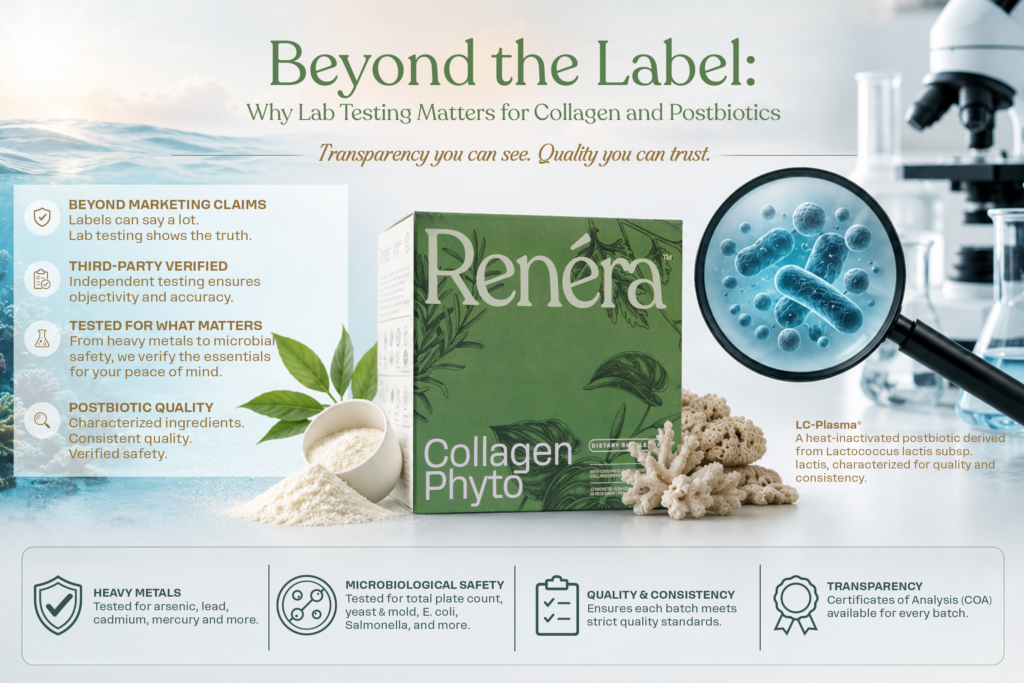
What makes a CoA useful is its specificity. It is tied to a production lot, not to the brand in general, which means it reflects an actual batch rather than a marketing aspiration. When a company can provide batch-level documentation, it signals a manufacturing process built around traceability.
A reasonable question to ask any supplement brand is simply whether batch-level testing documentation is available. The answer—and the ease of getting it—often tells you a great deal about how the product is made.
Why Heavy Metal Testing Matters for Marine Collagen
Marine collagen is valued for its low–molecular-weight peptides and easy solubility, a topic we cover in our article on the science of collagen absorption. But anything from the sea deserves a closer look at purity. Metals such as lead, arsenic, cadmium, and mercury can occur naturally in marine environments and may also enter waterways through human activities. These elements can bioaccumulate through aquatic food chains. This happens whether the fish is wild-caught or farmed, and no matter how clean the water looks.
The reassuring part is what independent testing actually shows. A 2025 peer-reviewed study in Open Medicine used ICP-MS—a highly sensitive analytical technique widely used for trace metal analysis.—to test marine collagen supplements from fish and jellyfish. None of the samples exceeded EU regulatory limits, and estimated daily intakes stayed safely below tolerable thresholds at recommended doses. Arsenic was the most common trace element, averaging 0.59 mg/kg, while mercury was detectable in only 12% of samples. Notably, no detectable levels of the measured toxic metals above the analytical detection limits—a reminder that source and processing genuinely shape the result.
This is exactly why heavy metal testing of collagen is a real checkpoint, not a marketing line. The same study also found meaningful variation among brands, underscoring the value of batch-level documentation over blanket assurances. Screening finished material for those metals is a recognized part of quality assurance, and certification programs such as NSF/ANSI 173 include contaminant requirements as part of broader quality standards, although testing protocols vary by certification.. Renéra Collagen Phyto uses low–molecular–weight marine collagen peptides (~2,000 Da) produced through enzymatic hydrolysis, in a clean-label approach that excludes artificial fillers.* Purity screening is simply how a marine ingredient earns its place in an intentional, low-tox lifestyle.
What the Research Adds
Purity is one half of trust. The research behind the ingredient is the other—and marine collagen peptides are among the more studied collagen formats.
The clearest picture comes from pooling many trials at once. A 2023 systematic review in Nutrients combined 26 randomized controlled trials and 1,721 participants, and found that hydrolyzed collagen significantly improved skin hydration and elasticity compared with placebo after consistent supplementation. Notably, 14 of those trials used collagen sourced from fish—so much of the evidence base sits with marine collagen specifically. Individual studies echo this: in one 12-week trial, women aged 45–60 taking hydrolyzed marine collagen saw a 35% reduction in wrinkle score from baseline, alongside improvements in elasticity and hydration.
A fair, honest note matters here. These results come from various marine collagen products, not from a study on Renéra’s ingredients, and the effects are real but modest. The mechanism is indirect—collagen peptides are digested, absorbed, and distributed throughout the body rather than being deposited directly into the skin. And the evidence isn’t unanimous: a 2025 meta-analysis found that, after stratification by funding source, several outcomes became smaller or statistically non-significant. No supplement can “reverse” aging or fully rebuild skin structure, and outcomes may vary depending on lifestyle, diet, sleep, stress, and individual health.* What the research does support is a credible, evidence-led case for why a well-made marine collagen peptide is worth formulating carefully—and worth verifying.
Postbiotic Quality: Verifying What You Can’t See
Postbiotics have their own quality and verification considerations, which differ from those of live probiotics. As defined by the International Scientific Association for Probiotics and Prebiotics (ISAPP), a postbiotic is a “preparation of inanimate microorganisms and/or their components that confers a health benefit on the host.” Because postbiotics are non-living, the relevant assurances differ from those for live probiotics—the focus shifts from viability and CFU counts toward a well-characterized, consistent preparation. We unpack that contrast in our piece on postbiotics versus probiotics. (← link bổ sung sau khi bài lên web)
For a postbiotic, quality depends on a well-characterized preparation, consistent manufacturing, and appropriate documentation of the source microorganism. Because postbiotics are intentionally inactivated, verification focuses less on viability and more on identity, consistency, and product quality. Renéra Collagen Phyto includes LC-Plasma (Lactococcus lactis subsp. lactis), a heat-inactivated postbiotic studied for its interaction with plasmacytoid dendritic cells (pDCs), immune cells involved in the body’s natural signaling.* Rather than “boosting” immunity, LC-Plasma is studied in the context of immune function and signaling—and its value in a finished product depends on a characterized, verifiable preparation rather than on any living-cell count.
Bringing It Together: Trust as a Practice
(body) Verification isn’t a single badge; it’s a set of habits a brand either keeps or doesn’t. Identity testing, potency assays, contaminant screening, and batch-level documentation together form a fuller picture of purity than any one claim on the front of a package. No single test, and no single ingredient, defines a product’s worth—but the willingness to measure and document is a meaningful signal.
For the intentional consumer, the practical takeaway is calm and simple: ask what was tested, ask whether the testing was independent, and ask to see the documentation. You can explore how this thinking directly shapes Renéra Collagen Phyto. Clean-label nutrition is most trustworthy when the label is the beginning of the conversation, not the end.
Frequently Asked Questions
What does “lab-tested” mean for a supplement?
It generally refers to laboratory analysis of an ingredient or finished product for identity, potency, and contaminants. The term is used broadly, so it’s worth asking what specifically was tested and whether the testing was independent.
What is a Certificate of Analysis (CoA)?
A CoA is a batch-specific document summarizing test results for a production lot—covering elements such as identity, potency, and contaminant screening. Because it’s tied to a specific batch, it reflects an actual production run rather than a general claim.
Why is heavy metal testing important for marine collagen?
Heavy metals can accumulate in marine environments through the food chain, so screening marine-derived ingredients for metals such as lead, arsenic, cadmium, and mercury is a recognized part of quality assurance and responsible sourcing.
How do you verify the quality and consistency of a postbiotic?
Because postbiotics are non-living, verification centers on confirming strain identity and a consistent, well-characterized preparation from batch to batch, rather than on the viability counts used for live probiotics.
Is third-party testing better than in-house testing?
Third-party testing is performed by an independent laboratory with no commercial stake in the result, which is widely regarded as a stronger form of assurance than manufacturer testing alone. Many brands use both.
References & Clinical Citations
- Consensus statement on the definition and scope of postbiotics. Nature Reviews Gastroenterology & Hepatology (ISAPP), 2021. https://www.nature.com/articles/s41575-021-00440-6
- Toxic metals and metalloids in collagen supplements of fish and jellyfish origin: risk assessment for daily intake (Cammilleri et al.). Open Medicine, 2025. https://www.ncbi.nlm.nih.gov/pmc/articles/PMC12032979/
- Effects of Oral Collagen for Skin Anti-Aging: A Systematic Review and Meta-Analysis (26 RCTs, 1,721 participants). Nutrients, 2023. https://www.ncbi.nlm.nih.gov/pmc/articles/PMC10180699/
- A randomized, triple-blind, placebo-controlled study evaluating a hydrolyzed marine collagen on skin wrinkles and elasticity. Journal of Cosmetic Dermatology, 2021. https://pubmed.ncbi.nlm.nih.gov/32799362/
- Effects of Collagen Supplements on Skin Aging: A Systematic Review and Meta-Analysis by funding source (23 RCTs). The American Journal of Medicine, 2025. https://www.sciencedirect.com/science/article/abs/pii/S0002934325002839
- Plasmacytoid dendritic cell activation by Lactococcus lactis strain Plasma (LC-Plasma). Nutrients. https://www.ncbi.nlm.nih.gov/pmc/articles/PMC6412444/
This article is for educational purposes only and reflects structure/function wellness information. These statements have not been evaluated by the Food and Drug Administration. This product is not intended to diagnose, treat, cure, or prevent any disease. Benefit claims marked with an asterisk reflect outcomes that may vary depending on lifestyle, diet, sleep, stress, and individual health.